The big idea
Kinematics describes how things move without asking why. Three quantities do all the work: position x, velocity v (how fast position changes) and acceleration a (how fast velocity changes). The graphs of these three are linked by slopes and areas, and reading them fluently is one of the most-tested skills on the AP exam.
Key ideas
- Velocity is the slope of the x–t graph. A straight line means constant velocity, and a curve means the velocity is changing.
- Acceleration is the slope of the v–t graph, and displacement is the area under it (area below the axis counts as negative).
- An object speeds up when v and a have the same sign and slows down when they have opposite signs. Negative acceleration does not automatically mean slowing down.
- The four constant-acceleration equations only work when a is constant. Pick the one that leaves out the quantity you don't know and don't need.
- In free fall, a = −g = −9.8 m/s² (taking up as positive), even at the very top of the path, where v = 0.
Equations
| v = v₀ + at | velocity after time t |
| x = x₀ + v₀t + ½at² | position after time t |
| v² = v₀² + 2aΔx | no time needed |
| v = dx/dt, a = dv/dt | calculus definitions (C: Mech) |
| Δx = ∫v dt | area under v–t |
Worked example
A car starts from rest and accelerates at 3.0 m/s² for 4.0 s, then drives at constant velocity for another 2.0 s. Find (a) its speed after 4.0 s and (b) the total distance travelled.
- (a) Constant acceleration from rest: v = v₀ + at = 0 + (3.0)(4.0) = 12 m/s.
- (b) Phase 1: Δx₁ = ½at² = ½(3.0)(4.0)² = 24 m.
- Phase 2 (constant v): Δx₂ = vt = (12)(2.0) = 24 m.
- Check with the v–t graph: a triangle (½·4·12 = 24) plus a rectangle (2·12 = 24) gives a total area of 48 m.
Common mistakes
- Confusing the value of a graph with its slope. On an x–t graph, the height is position, not velocity.
- Saying "a = 0 at the top" of a vertical throw. The velocity is zero there, but the acceleration is still −9.8 m/s².
- Using the constant-acceleration equations across two phases with different accelerations. Split the motion into parts.
Try it yourself
A ball is thrown straight up at 15 m/s. How long does it take to reach the top, and how high does it go?
Show the answer
t = v₀/g = 15/9.8 ≈ 1.5 s; h = v₀²/(2g) = 225/19.6 ≈ 11.5 m.
Going deeper: AP Physics 1
Exam-level reasoning in algebra: answers in symbols, "what happens if it doubles?" questions, multi-step problems and the conceptual traps the AP Physics 1 exam likes to set.
Read graphs the way the exam does
Exam graph questions test three skills. (1) Read slopes: x–t slope is v, and v–t slope is a. (2) Read areas: the area under v–t is displacement, and the area under a–t is Δv. (3) Translate between graphs: a straight, sloped v–t line becomes a parabola on x–t and a flat line on a–t. If x–t curves upward (concave up), the acceleration is positive.
Proportional reasoning from rest
With a = constant and v₀ = 0, d = ½at² and v² = 2ad. So d ∝ t² and v ∝ √d. Double the time and the distance quadruples. Drop from four times the height and you land twice as fast, after twice the time. The distances covered in successive equal time intervals go 1 : 3 : 5 : 7…
Free-fall symmetry
For a ball thrown straight up (no air resistance): the time up equals the time down, it passes each height at the same speed going up and coming down, and a = −g everywhere, including the top.
More worked examples
Example 1. A car waiting at a light starts with a = 2.0 m/s² just as a truck passes it at a constant 12 m/s. (a) When does the car catch the truck? (b) How far have they gone? (c) How fast is the car going then?
- Same start point, so set the positions equal: ½(2.0)t² = 12t.
- t = 0 (the start) or t = 12 s.
- x = 12 × 12 = 144 m.
- vcar = at = 24 m/s, exactly twice the truck's speed. That always happens: equal average velocities mean the car's final speed is 2 × 12.
Example 2. A ball is thrown upward at 15 m/s from the edge of a 25 m tall roof and lands on the ground below. Find the time in the air and the landing speed.
- Up positive, origin at the roof: −25 = 15t − 4.9t² → 4.9t² − 15t − 25 = 0.
- Positive root: t = (15 + √(225 + 490))/9.8 = 4.3 s.
- Landing speed: v² = 15² + 2(9.8)(25) = 715 → v = 26.7 m/s. You get the same answer if it is thrown down at 15 m/s, since it passes the roof again at 15 m/s downward.
Exam-style practice
1. An object starts from rest with constant acceleration and travels distance d in the first second. How far does it travel in the first 3 s? In the 3rd second alone?
Show the solution
d ∝ t², so 9d in 3 s. The 3rd second alone covers 9d − 4d = 5d.
2. A ball is dropped from height h and hits the ground at speed v. From what height must it be dropped to land at 2v?
Show the solution
v ∝ √h, so the height must be 4h.
3. On a v–t graph the line is below the axis but sloping upward. Is the object speeding up or slowing down?
Show the solution
v is negative and a is positive (opposite signs), so it is slowing down.
Going deeper: AP Physics C
This part goes beyond the algebra course: calculus derivations, harder multi-step problems and exam-style practice, written at the level of the AP Physics C exam.
Calculus definitions
Velocity and acceleration are derivatives. If you know x(t), differentiate it to get v(t), and differentiate again to get a(t). Going the other way, integrate and add the initial conditions:
v(t) = v₀ + ∫₀ᵗ a(t′) dt′ x(t) = x₀ + ∫₀ᵗ v(t′) dt′With constant acceleration these integrals give exactly the "big five" equations. That's where they come from, and why they fail when a is not constant.
Distance vs. displacement
Displacement is xf − xi. Distance adds up the path length, so you must find every moment where v = 0 (the object turns around) and add the absolute values of each leg.
When a depends on velocity
If a = −kv (a drag-like deceleration), write dv/dt = −kv, separate the variables (dv/v = −k dt) and integrate: v = v₀e−kt. Integrating again gives the total stopping distance, x = v₀/k. These separable differential equations show up often on the C exam.
More worked examples
Example 1. A particle moves along x with x(t) = 2t³ − 9t² + 12t (metres, seconds). (a) When is it at rest? (b) Find its acceleration at those times. (c) What distance does it travel from t = 0 to t = 3 s?
- v = dx/dt = 6t² − 18t + 12 = 6(t − 1)(t − 2), so it is at rest at t = 1 s and t = 2 s.
- a = dv/dt = 12t − 18: a(1) = −6 m/s² and a(2) = +6 m/s².
- Positions: x(0) = 0, x(1) = 5, x(2) = 4, x(3) = 9 m.
- Distance = |5 − 0| + |4 − 5| + |9 − 4| = 5 + 1 + 5 = 11 m (the displacement is only 9 m).
Example 2. An object has a(t) = 6t − 4 (m/s²), with v₀ = 3 m/s and x₀ = 2 m. Find v and x at t = 2 s.
- v(t) = 3 + ∫₀ᵗ(6t′ − 4)dt′ = 3t² − 4t + 3.
- x(t) = 2 + ∫₀ᵗ(3t′² − 4t′ + 3)dt′ = t³ − 2t² + 3t + 2.
- At t = 2: v = 12 − 8 + 3 = 7 m/s, and x = 8 − 8 + 6 + 2 = 8 m.
Example 3. A boat cuts its engine at 20 m/s and slows with a = −kv, where k = 0.50 s⁻¹. Find v(t) and the total distance it coasts.
- dv/dt = −kv → ∫dv/v = −k∫dt → ln(v/v₀) = −kt.
- v(t) = 20e−0.5t m/s. It never quite reaches zero.
- Distance = ∫₀^∞ v dt = v₀/k = 20/0.5 = 40 m.
Exam-style practice
1. If x(t) = 5 sin(2t), what is the maximum speed?
Show the solution
v = 10 cos(2t), so vmax = 10 m/s.
2. A car's v–t graph is a straight line from 0 to 12 m/s over 4 s, then constant for 6 s. What is its average velocity over the 10 s?
Show the solution
Area = 24 + 72 = 96 m, so vavg = 96/10 = 9.6 m/s.
3. v(t) = 4 − t² m/s. Find the displacement and the distance travelled from t = 0 to 3 s.
Show the solution
Displacement = ∫₀³(4 − t²)dt = 12 − 9 = 3 m. It turns around at t = 2 s: the first leg is 16/3 m and the second is |3 − 16/3| = 7/3 m, so distance = 23/3 ≈ 7.7 m.
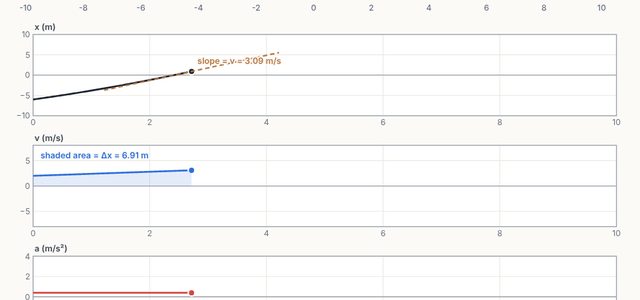
Open the Motion Graphs simulation and test every idea on this page yourself.
Open the simulation →