The big idea
A vector has a size and a direction, and nearly every quantity in AP Physics C, from displacement and force to electric and magnetic fields, is one. Doing physics with vectors comes down to three skills: breaking a vector into components, multiplying two vectors to get a scalar (the dot product), and multiplying two vectors to get a new vector (the cross product).
Key ideas
- Break every vector into components along perpendicular axes: Ax = A cos θ and Ay = A sin θ, with θ measured from the +x axis.
- To add vectors, add their components. Never add the magnitudes, unless the vectors are parallel.
- The dot product measures how much two vectors point the same way, and gives a scalar: A·B = AB cos θ.
- The cross product gives a vector perpendicular to both, with size AB sin θ and direction from the right-hand rule.
- Order matters for the cross product: B × A = −A × B. It doesn't matter for the dot product.
Equations
| |A| = √(Ax² + Ay² + Az²) | magnitude |
| A·B = AB cos θ = AxBx + AyBy + AzBz | dot product (scalar) |
| |A × B| = AB sin θ | cross product size |
| î × ĵ = k̂, ĵ × k̂ = î, k̂ × î = ĵ | unit-vector cycle |
| W = F·d, τ = r × F, F = qv × B | where they appear |
Worked example
A hiker walks 3.0 km east and then 4.0 km at 60° north of east. Find the magnitude and direction of her total displacement.
- First leg: (3.0, 0) km.
- Second leg: (4.0 cos 60°, 4.0 sin 60°) = (2.0, 3.46) km.
- Sum: (5.0, 3.46) km → magnitude √(25 + 12.0) = 6.1 km.
- Direction: tan θ = 3.46/5.0 → θ = 35° north of east.
Common mistakes
- Adding magnitudes: 3 km + 4 km is not 7 km unless both legs point the same way.
- Using the wrong trig function. The component adjacent to the angle gets the cosine.
- Forgetting the minus sign when the order of a cross product is reversed, or using the left hand.
Try it yourself
Find the angle between A = î + ĵ and B = î.
Show the answer
A·B = 1, |A| = √2 and |B| = 1, so cos θ = 1/√2 and θ = 45°.
Going deeper: AP Physics 1
Exam-level reasoning in algebra: answers in symbols, "what happens if it doubles?" questions, multi-step problems and the conceptual traps the AP Physics 1 exam likes to set.
Signs carry the direction
On the AP 1 exam most vectors live in one or two dimensions. Pick a positive direction, write every component with its sign, and the algebra does the rest. A component is negative when it points against your chosen axis, not when the vector is "small". To find a direction from components, sketch the vector first, so you know which quadrant the angle belongs in.
Relative velocity
Velocities add as vectors: the velocity of a boat relative to the ground is its velocity relative to the water plus the water's velocity relative to the ground. Perpendicular parts act independently: a sideways current never changes how long it takes to cross a river.
vboat, ground = vboat, water + vwater, groundMore worked examples
Example 1. A boat heads straight across an 80 m wide river at 4.0 m/s relative to the water. The current flows at 3.0 m/s. Find the crossing time, how far downstream it lands, and its speed relative to the shore.
- Across: t = 80/4.0 = 20 s. The current has no effect on this.
- Downstream drift: 3.0 × 20 = 60 m.
- Speed relative to the shore: √(4.0² + 3.0²) = 5.0 m/s, at tan⁻¹(3/4) = 37° downstream of straight across.
Example 2. A plane points due north at 200 m/s while a wind blows east at 50 m/s. Find its ground speed and direction.
- The components are perpendicular, so add them with Pythagoras: √(200² + 50²) = 206 m/s.
- Angle east of north: tan θ = 50/200 → θ = 14°.
Exam-style practice
1. Two forces of 6 N and 8 N act on an object. What are the largest and smallest possible net forces?
Show the solution
Largest when parallel, 14 N; smallest when opposite, 2 N. At 90° apart the net force is 10 N.
2. To cross the river above in the shortest distance, which way should the boat point?
Show the solution
Angled upstream so that the current is cancelled: sin θ = 3/4, so θ ≈ 49° upstream. Its speed across is then √(16 − 9) ≈ 2.6 m/s, so the crossing takes longer (≈ 30 s).
Going deeper: AP Physics C
This part goes beyond the algebra course: calculus derivations, harder multi-step problems and exam-style practice, written at the level of the AP Physics C exam.
Components and unit vectors
Any vector can be written in terms of the unit vectors î, ĵ, k̂: A = Axî + Ayĵ + Azk̂. Adding vectors means adding matching components, and multiplying by a scalar multiplies every component. The magnitude follows from Pythagoras, and in two dimensions the direction comes from tan θ = Ay/Ax. Check the quadrant, because a calculator only returns angles between −90° and +90°.
|A| = √(Ax² + Ay² + Az²)The dot product: "how much do they line up?"
The dot product turns two vectors into a scalar. It is largest when the vectors are parallel, zero when they are perpendicular, and negative when they point more than 90° apart. Physics uses it whenever only the parallel part matters: work (W = F·d), flux (Φ = E·A) and power (P = F·v).
A·B = AB cos θ = AxBx + AyBy + AzBzSetting the two forms equal is the standard way to find the angle between two vectors given in components.
The cross product: "how much do they twist?"
The cross product makes a new vector perpendicular to both of the originals, with magnitude AB sin θ, which is the area of the parallelogram they span. Its direction comes from the right-hand rule: fingers along A, curl toward B, and your thumb points along A × B. It is anti-commutative: B × A = −A × B. It appears in torque (τ = r × F), angular momentum (L = r × p) and the magnetic force (F = qv × B).
A × B = (AyBz − AzBy)î + (AzBx − AxBz)ĵ + (AxBy − AyBx)k̂Useful shortcuts: î × ĵ = k̂, ĵ × k̂ = î, k̂ × î = ĵ, and any unit vector crossed with itself is zero.
More worked examples
Example 1. Given A = 3î − 2ĵ + k̂ and B = î + 4ĵ − 2k̂, find A·B and the angle between them.
- A·B = (3)(1) + (−2)(4) + (1)(−2) = 3 − 8 − 2 = −7.
- |A| = √(9 + 4 + 1) = √14 ≈ 3.74, and |B| = √(1 + 16 + 4) = √21 ≈ 4.58.
- cos θ = −7 / (3.74 × 4.58) = −0.408, so θ ≈ 114°. The negative dot product means the angle is obtuse.
Example 2. For the same two vectors, find A × B, and check that it is perpendicular to A.
- x: (−2)(−2) − (1)(4) = 4 − 4 = 0.
- y: (1)(1) − (3)(−2) = 1 + 6 = 7.
- z: (3)(4) − (−2)(1) = 12 + 2 = 14.
- So A × B = 7ĵ + 14k̂. Check: (7ĵ + 14k̂)·A = 0 − 14 + 14 = 0 ✓
Example 3. A force F = (4î + 3ĵ) N moves an object through a displacement d = (5î − 2ĵ) m. How much work does it do?
- Work is a dot product: W = F·d.
- W = (4)(5) + (3)(−2) = 20 − 6 = 14 J.
- Only the part of the force along the displacement does work, which is exactly what the dot product extracts.
Exam-style practice
1. Find the value of b that makes A = 2î + bĵ perpendicular to B = 6î − 4ĵ.
Show the solution
Perpendicular means A·B = 0: 12 − 4b = 0, so b = 3.
2. A position vector r = 2î m and a force F = 5ĵ N act on a wrench. Find the torque τ = r × F.
Show the solution
τ = (2)(5)(î × ĵ) = 10k̂ N·m, which is counter-clockwise, out of the page.
3. What is |A × B| if |A| = 4, |B| = 5 and A·B = 10?
Show the solution
cos θ = 10/20 = 0.5, so θ = 60° and |A × B| = 20 sin 60° ≈ 17.3.
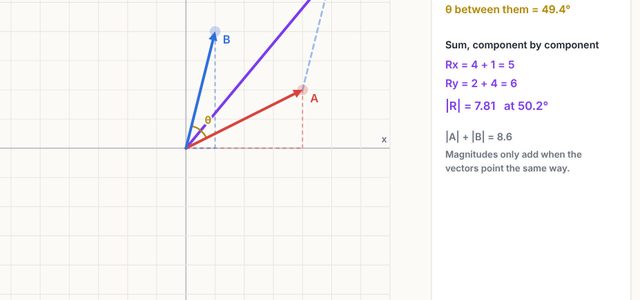
Open the Vectors: Add, Dot & Cross simulation and test every idea on this page yourself.
Open the simulation →