The big idea
A Level differentiation adds new functions (ex, ln x, sin x, cos x) and three rules for combining them. It also handles curves that are not given as y = f(x): implicit equations and parametric equations.
Key ideas
- Chain rule: differentiate the outside, multiply by the derivative of the inside.
- Product rule: u′v + uv′. Quotient rule: (u′v − uv′)/v².
- Implicit: differentiating a y-term brings a factor dy/dx.
- Parametric: dy/dx = (dy/dt) ÷ (dx/dt).
- Connected rates of change use the chain rule: dV/dt = (dV/dr)(dr/dt).
Equations
| (ekx)′ = kekx, (ln x)′ = 1/x | exponential and log |
| (sin kx)′ = k cos kx, (cos kx)′ = −k sin kx | trig |
| (uv)′ = u′v + uv′, (u/v)′ = (u′v − uv′)/v2 | product and quotient |
| dy/dx = (dy/dt)/(dx/dt) | parametric |
Worked questions: easy, medium, hard
Three questions that climb in difficulty, each solved one step at a time. Try each one before you read the steps.
Differentiate y = e3x and y = ln(2x).
- e3x: the inside 3x differentiates to 3, so dy/dx = 3e3x.
- ln(2x) = ln 2 + ln x.
- So its derivative is 1/x.
Differentiate y = x2 sin x and y = (2x + 1)5.
- Product rule: u = x2, v = sin x.
- dy/dx = 2x sin x + x2 cos x.
- Chain rule: 5(2x + 1)4 × 2.
- = 10(2x + 1)4.
A curve has parametric equations x = t2, y = 2t3. Find dy/dx in terms of t and the equation of the tangent at t = 1.
- dx/dt = 2t and dy/dt = 6t2.
- dy/dx = 6t2/(2t) = 3t.
- At t = 1 the point is (1, 2) and the gradient is 3.
- Tangent: y − 2 = 3(x − 1), so y = 3x − 1.
Common mistakes
- Forgetting the inside derivative in the chain rule.
- Writing the derivative of cos as +sin.
- Dividing dx/dt by dy/dt.
Now you try: easy to hard
Six more questions, two at each level. These are the questions on the worksheet; each solution opens when you are ready.
Easy 1. Differentiate y = cos 4x.
Show the step-by-step solution
dy/dx = −4 sin 4x.
Easy 2. Differentiate y = ex2.
Show the step-by-step solution
Inside x2 differentiates to 2x: dy/dx = 2xex2.
Medium 3. Differentiate y = x/(x2 + 1).
Show the step-by-step solution
Quotient rule: [1(x2 + 1) − x(2x)]/(x2 + 1)2 = (1 − x2)/(x2 + 1)2.
Medium 4. Find the stationary point of y = xe−2x.
Show the step-by-step solution
dy/dx = e−2x − 2xe−2x = e−2x(1 − 2x) = 0 at x = 1/2. y = (1/2)e−1 = 0.184, so the point is (0.5, 0.184).
Hard 5. Find dy/dx at (1, 2) on the curve x2 + 3xy + y2 = 11.
Show the step-by-step solution
2x + 3y + 3x(dy/dx) + 2y(dy/dx) = 0, so dy/dx = −(2x + 3y)/(3x + 2y) = −8/7. dy/dx = −8/7.
Hard 6. The radius of a sphere increases at 0.2 cm/s. Find the rate of increase of its volume when r = 5 cm.
Show the step-by-step solution
dV/dr = 4πr2 = 100π. dV/dt = 100π × 0.2 = 20π = 62.8 cm³/s.
6 questions to print or save, with full step-by-step answers at the end.
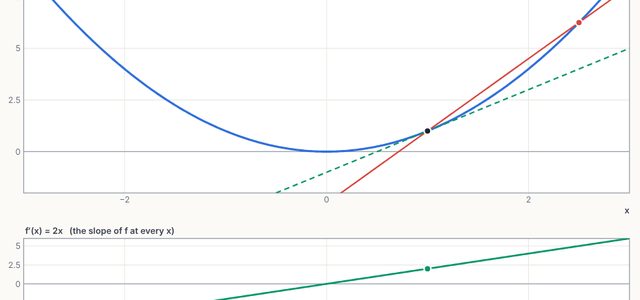
Open the Derivative Explorer simulation and test every idea on this page yourself.
Open the simulation →