The big idea
Integration has no single rule that always works, so the skill is recognising which method fits. Look for a function next to its own derivative (substitution), a product of two different types (by parts), or a fraction with a factorised denominator (partial fractions).
Key ideas
- Reverse the chain rule for linear insides: ∫ ekx dx = ekx/k.
- ∫ f′(x)/f(x) dx = ln|f(x)| + c.
- Substitution: choose u as the inside function and change dx as well.
- By parts: ∫ u dv = uv − ∫ v du. Choose u to be the part that gets simpler when differentiated (ln x always goes as u).
- Use cos 2x identities to integrate sin² x and cos² x.
Equations
| ∫ ekx dx = ekx/k + c | exponential |
| ∫ cos kx dx = (1/k) sin kx + c, ∫ sin kx dx = −(1/k) cos kx + c | trig |
| ∫ f′(x)/f(x) dx = ln|f(x)| + c | log form |
| ∫ u dv = uv − ∫ v du | by parts |
Worked questions: easy, medium, hard
Three questions that climb in difficulty, each solved one step at a time. Try each one before you read the steps.
Find ∫ e2x dx and ∫ cos 3x dx.
- Divide by the coefficient of x: ∫ e2x dx = (1/2)e2x + c.
- cos integrates to sin.
- ∫ cos 3x dx = (1/3) sin 3x + c.
Find ∫ x(x2 + 3)4 dx.
- The derivative of the inside, 2x, is almost present. Let u = x2 + 3, so du = 2x dx and x dx = du/2.
- ∫ (1/2)u4 du = u5/10 + c.
- = (x2 + 3)5/10 + c.
Evaluate ∫0π/2 x cos x dx.
- By parts with u = x and dv = cos x dx: du = dx, v = sin x.
- ∫ x cos x dx = x sin x − ∫ sin x dx = x sin x + cos x.
- At π/2: π/2 + 0. At 0: 0 + 1.
- = π/2 − 1 ≈ 0.571.
Common mistakes
- Multiplying by k instead of dividing when integrating ekx.
- Forgetting to change dx in a substitution.
- Sign errors in the second term of integration by parts.
Now you try: easy to hard
Six more questions, two at each level. These are the questions on the worksheet; each solution opens when you are ready.
Easy 1. Find ∫ 1/(2x + 1) dx.
Show the step-by-step solution
(1/2) ln|2x + 1| + c.
Easy 2. Evaluate ∫0π/2 sin 2x dx.
Show the step-by-step solution
[−(1/2) cos 2x] from 0 to π/2 = 1/2 + 1/2 = 1.
Medium 3. Find ∫ 2x/(x2 + 1) dx.
Show the step-by-step solution
The top is the derivative of the bottom: ln(x2 + 1) + c.
Medium 4. Find ∫ sin2 x dx.
Show the step-by-step solution
sin2 x = (1 − cos 2x)/2, so the integral is x/2 − (sin 2x)/4 + c.
Hard 5. Find ∫ (x + 7)/[(x − 1)(x + 3)] dx.
Show the step-by-step solution
Partial fractions: 2/(x − 1) − 1/(x + 3). Integral: 2 ln|x − 1| − ln|x + 3| + c.
Hard 6. Find ∫ xe3x dx.
Show the step-by-step solution
u = x, dv = e3x dx, v = e3x/3. xe3x/3 − e3x/9 + c.
6 questions to print or save, with full step-by-step answers at the end.
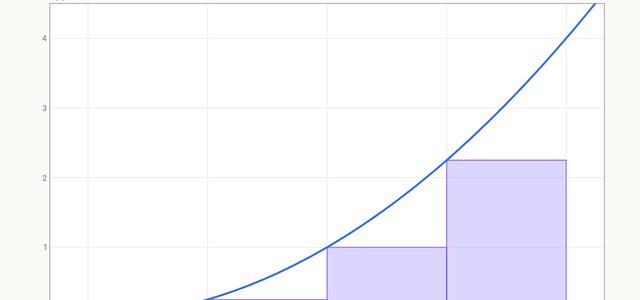
Open the Riemann Sums & the Fundamental Theorem simulation and test every idea on this page yourself.
Open the simulation →