The big idea
A differential equation describes how a quantity changes. If the variables can be separated, with all the y terms on one side and all the x terms on the other, each side can be integrated. A starting condition then picks out one solution from the family.
Key ideas
- "The rate of change of N is proportional to N" translates to dN/dt = kN.
- Separate, integrate both sides, and include one constant.
- Use the initial condition to find the constant before rearranging if that is easier.
- dN/dt = kN always gives N = N₀ekt.
Equations
| dy/dx = f(x)g(y) ⇒ ∫ dy/g(y) = ∫ f(x) dx | separating variables |
| dN/dt = kN ⇒ N = N0ekt | exponential model |
| dT/dt = −k(T − Ts) | Newton's law of cooling |
| ln|y| = F(x) + c ⇒ y = AeF(x) | removing the log |
Worked questions: easy, medium, hard
Three questions that climb in difficulty, each solved one step at a time. Try each one before you read the steps.
Solve dy/dx = 6x2 given that y = 1 when x = 0.
- Integrate: y = 2x3 + c.
- Substitute x = 0, y = 1: c = 1.
- y = 2x3 + 1.
Solve dy/dx = 2xy given that y = 4 when x = 0.
- Separate: dy/y = 2x dx.
- Integrate: ln|y| = x2 + c.
- So y = Aex2, and y(0) = 4 gives A = 4.
- y = 4ex2.
A population grows at a rate proportional to its size. It is 100 at t = 0 and 300 at t = 5. When does it reach 1000?
- dN/dt = kN gives N = 100ekt.
- At t = 5: 300 = 100e5k, so k = (ln 3)/5 = 0.2197.
- Set N = 1000: ekt = 10, so t = (ln 10)/k.
- t = 2.3026/0.2197 = 10.5.
Common mistakes
- Integrating y terms with respect to x.
- Adding the constant after exponentiating instead of before.
- Assuming growth is linear between two data points.
Now you try: easy to hard
Six more questions, two at each level. These are the questions on the worksheet; each solution opens when you are ready.
Easy 1. Solve dy/dx = e−x with y = 2 when x = 0.
Show the step-by-step solution
y = −e−x + c. At x = 0: 2 = −1 + c, so c = 3. y = 3 − e−x.
Easy 2. Verify that y = Ae3x satisfies dy/dx = 3y.
Show the step-by-step solution
dy/dx = 3Ae3x = 3y. It does, for any A.
Medium 3. Solve dy/dx = x/y with y = 3 when x = 0.
Show the step-by-step solution
y dy = x dx gives y2/2 = x2/2 + c. With (0, 3): y2 = x2 + 9, so y = √(x2 + 9).
Medium 4. Solve dy/dx = y cos x with y = 1 when x = 0.
Show the step-by-step solution
dy/y = cos x dx gives ln y = sin x + c, and c = 0. y = esin x.
Hard 5. A drink cools in a 20 °C room from 80 °C to 50 °C in 10 minutes. Find its temperature after 20 minutes.
Show the step-by-step solution
T − 20 = 60e−kt. At t = 10: 30 = 60e−10k, so e−10k = 1/2. At t = 20: T = 20 + 60 × 1/4 = 35 °C.
Hard 6. Solve dy/dx = (1 + y)/x for x > 0, given y = 1 when x = 1.
Show the step-by-step solution
dy/(1 + y) = dx/x gives ln(1 + y) = ln x + c, so 1 + y = Ax. At (1, 1): A = 2. y = 2x − 1.
6 questions to print or save, with full step-by-step answers at the end.
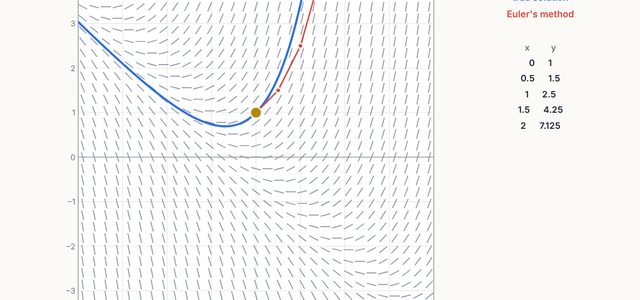
Open the Slope Fields & Euler's Method simulation and test every idea on this page yourself.
Open the simulation →