The big idea
Many equations cannot be solved exactly. Numerical methods get as close as you like instead. A change of sign shows there is a root in an interval; an iteration or the Newton–Raphson formula then homes in on it.
Key ideas
- If f is continuous and f(a) and f(b) have opposite signs, there is a root between a and b.
- Fixed-point iteration: rearrange f(x) = 0 as x = g(x) and repeat xn+1 = g(xn).
- Newton–Raphson follows the tangent to the x-axis. It fails if f′(xn) = 0.
- The trapezium rule overestimates for a curve that is concave up and underestimates for concave down.
Equations
| xn+1 = g(xn) | fixed-point iteration |
| xn+1 = xn − f(xn)/f′(xn) | Newton–Raphson |
| ∫ ≈ (h/2)[y0 + 2(y1 + … + yn−1) + yn] | trapezium rule |
| f(a)f(b) < 0 ⇒ root in (a, b) | sign change |
Worked questions: easy, medium, hard
Three questions that climb in difficulty, each solved one step at a time. Try each one before you read the steps.
Show that x3 + x − 3 = 0 has a root between 1 and 2.
- Let f(x) = x3 + x − 3, which is continuous.
- f(1) = −1 and f(2) = 7.
- The sign changes, so there is a root between 1 and 2.
Use the iteration xn+1 = ∛(3 − xn) with x0 = 1 to find the root of x3 + x − 3 = 0 to 2 decimal places.
- x1 = ∛2 = 1.2599.
- x2 = ∛1.7401 = 1.2028 and x3 = ∛1.7972 = 1.2158.
- x4 = ∛1.7842 = 1.2129, x5 = 1.2135.
- The values settle at 1.21.
Apply Newton–Raphson to f(x) = x3 + x − 3 starting from x0 = 1. Find x3.
- f′(x) = 3x2 + 1. x1 = 1 − (−1)/4 = 1.25.
- f(1.25) = 0.2031, f′(1.25) = 5.6875: x2 = 1.25 − 0.0357 = 1.2143.
- f(1.2143) = 0.0048, f′(1.2143) = 5.4235: x3 = 1.2143 − 0.0009.
- x3 = 1.2134, already correct to 4 decimal places.
Common mistakes
- Claiming a root from a sign change when the function is not continuous (for example across an asymptote).
- Rounding too early in an iteration.
- Forgetting the factor of 2 on the middle ordinates of the trapezium rule.
Now you try: easy to hard
Six more questions, two at each level. These are the questions on the worksheet; each solution opens when you are ready.
Easy 1. Show that x2 − 5 = 0 has a root between 2 and 3.
Show the step-by-step solution
f(2) = −1 and f(3) = 4: a sign change in a continuous function, so there is a root in (2, 3).
Easy 2. Use the trapezium rule with 2 strips to estimate ∫02 x3 dx.
Show the step-by-step solution
h = 1, ordinates 0, 1, 8. (1/2)[0 + 2(1) + 8] = 5 (the exact value is 4; the curve is concave up, so this is an overestimate).
Medium 3. Use xn+1 = (xn2 + 2)/5 with x0 = 0 to find a root of x2 − 5x + 2 = 0 to 2 decimal places.
Show the step-by-step solution
x1 = 0.4, x2 = 0.432, x3 = 0.4373, x4 = 0.4382. x ≈ 0.44.
Medium 4. Use Newton–Raphson on f(x) = x2 − 2 from x0 = 1 to find √2 to 4 decimal places.
Show the step-by-step solution
xn+1 = xn − (xn2 − 2)/(2xn): 1.5, 1.4167, 1.4142. √2 ≈ 1.4142.
Hard 5. Use the trapezium rule with 4 strips to estimate ∫13 (1/x) dx.
Show the step-by-step solution
h = 0.5, ordinates 1, 0.6667, 0.5, 0.4, 0.3333. (0.5/2)[1 + 0.3333 + 2(1.5667)] = 0.25 × 4.4667 = 1.117 (exact: ln 3 = 1.099).
Hard 6. Explain why Newton–Raphson fails for f(x) = x3 − 3x + 1 with x0 = 1.
Show the step-by-step solution
f′(x) = 3x2 − 3, so f′(1) = 0. The formula divides by zero: the tangent at x = 1 is horizontal and never meets the x-axis.
6 questions to print or save, with full step-by-step answers at the end.
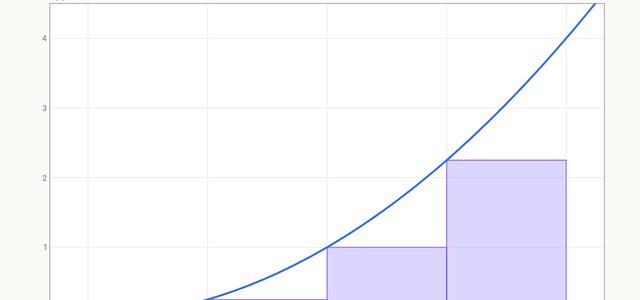
Open the Riemann Sums & the Fundamental Theorem simulation and test every idea on this page yourself.
Open the simulation →