The big idea
AS mechanics models moving objects as particles. With constant acceleration the suvat equations connect displacement, velocities, acceleration and time. Forces enter through Newton's second law, F = ma, applied to each object separately.
Key ideas
- List s, u, v, a, t; choose the equation that contains the four you have or need.
- Choose a positive direction and keep to it. Under gravity, a = −9.8 m/s² if up is positive.
- At the highest point of a vertical throw, v = 0.
- Newton's second law: resultant force = mass × acceleration.
- For connected particles, write F = ma for each particle; the tension is the same throughout a light string.
Equations
| v = u + at | no s |
| s = ut + (1/2)at2 | no v |
| v2 = u2 + 2as | no t |
| F = ma | Newton's second law |
Worked questions: easy, medium, hard
Three questions that climb in difficulty, each solved one step at a time. Try each one before you read the steps.
A particle starts at 5 m/s and accelerates at 2 m/s² for 4 s. Find its final velocity and the distance travelled.
- v = u + at = 5 + 2 × 4 = 13 m/s.
- s = ut + (1/2)at2 = 20 + (1/2)(2)(16).
- s = 36 m.
A ball is thrown vertically upward at 15 m/s. Taking g = 9.8 m/s², find the greatest height and the time before it returns to the start.
- At the top v = 0: 0 = 152 − 2(9.8)s, so s = 225/19.6 = 11.5 m.
- Back at the start, s = 0: 0 = 15t − 4.9t2.
- t(15 − 4.9t) = 0, so t = 15/4.9 = 3.06 s.
A 3 kg block on a smooth horizontal table is joined by a light string over a smooth pulley to a 2 kg mass hanging freely. Find the acceleration and the tension.
- Hanging mass (down positive): 2g − T = 2a.
- Block on the table: T = 3a.
- Add: 2g = 5a, so a = 19.6/5 = 3.92 m/s².
- T = 3 × 3.92 = 11.8 N.
Common mistakes
- Mixing signs for up and down in the same equation.
- Using suvat when the acceleration is not constant.
- Using the weight of the hanging mass as the tension.
Now you try: easy to hard
Six more questions, two at each level. These are the questions on the worksheet; each solution opens when you are ready.
Easy 1. A particle starts from rest and accelerates at 3 m/s² over 24 m. Find its final speed.
Show the step-by-step solution
v2 = 0 + 2(3)(24) = 144, so v = 12 m/s.
Easy 2. A car slows from 20 m/s to rest in 50 m. Find its acceleration.
Show the step-by-step solution
0 = 400 + 2a(50), so a = −4 m/s².
Medium 3. A 1200 kg car has a driving force of 3000 N and resistance 600 N. Find its acceleration.
Show the step-by-step solution
3000 − 600 = 1200a, so a = 2 m/s².
Medium 4. A 70 kg person stands in a lift accelerating upward at 1.5 m/s². Find the reaction from the floor.
Show the step-by-step solution
R − 70g = 70(1.5), so R = 70(9.8 + 1.5) = 791 N.
Hard 5. A cyclist accelerates from rest at 2 m/s² for 5 s, then rides at constant speed for 10 s. Find the total distance.
Show the step-by-step solution
First stage: s = (1/2)(2)(25) = 25 m, reaching 10 m/s. Second: 10 × 10 = 100 m. Total 125 m.
Hard 6. A particle has velocity v = 3t2 − 12t (m/s). Find its acceleration at t = 3, when it is at rest, and its displacement from t = 0 to t = 4.
Show the step-by-step solution
a = 6t − 12 = 6 m/s². At rest when 3t(t − 4) = 0: t = 0 and t = 4 s. Displacement = [t3 − 6t2] from 0 to 4 = 64 − 96 = −32 m.
6 questions to print or save, with full step-by-step answers at the end.
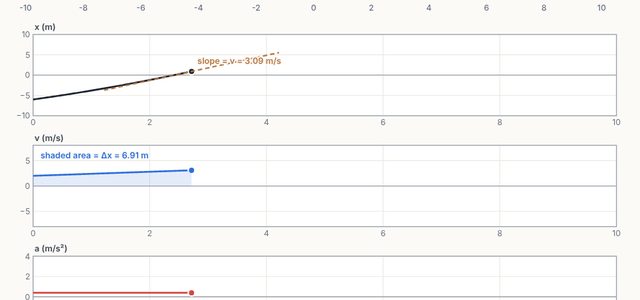
Open the Motion Graphs simulation and test every idea on this page yourself.
Open the simulation →