The big idea
Integration reverses differentiation. An indefinite integral gives a family of curves (hence + c); a point on the curve fixes c. A definite integral between two limits gives the area between a curve and the x-axis.
Key ideas
- Raise the power by one and divide by the new power. Always add + c to an indefinite integral.
- Use a known point to find c.
- Definite integral: substitute the upper limit, then subtract the value at the lower limit.
- Area below the x-axis comes out negative. For the area between two curves, integrate (top − bottom).
Equations
| ∫ xn dx = xn+1/(n + 1) + c | n ≠ −1 |
| ∫ab f(x) dx = F(b) − F(a) | definite integral |
| Area = ∫ab (top − bottom) dx | between curves |
| y = ∫ (dy/dx) dx | curve from gradient |
Worked questions: easy, medium, hard
Three questions that climb in difficulty, each solved one step at a time. Try each one before you read the steps.
Find ∫ (3x2 + 4x) dx.
- 3x2 integrates to x3.
- 4x integrates to 2x2.
- x3 + 2x2 + c.
Evaluate ∫14 (2x + 1/√x) dx.
- Rewrite 1/√x as x−1/2, which integrates to 2x1/2.
- Antiderivative: x2 + 2√x.
- At 4: 16 + 4 = 20. At 1: 1 + 2 = 3.
- 20 − 3 = 17.
Find the area enclosed between the curve y = 4x − x2 and the line y = x.
- Intersections: 4x − x2 = x gives x(3 − x) = 0, so x = 0 and x = 3.
- The curve is above the line between them.
- Area = ∫03 (3x − x2) dx = [3x2/2 − x3/3] from 0 to 3.
- = 13.5 − 9 = 4.5.
Common mistakes
- Forgetting + c.
- Subtracting the limits the wrong way round.
- Adding a positive and a negative area and getting a total that is too small.
Now you try: easy to hard
Six more questions, two at each level. These are the questions on the worksheet; each solution opens when you are ready.
Easy 1. Find ∫ 6x5 dx.
Show the step-by-step solution
x6 + c.
Easy 2. Find ∫ (x2 − 2/x2) dx.
Show the step-by-step solution
x3/3 − 2(x−1/(−1)) = x3/3 + 2/x + c.
Medium 3. Evaluate ∫03 (x2 + 1) dx.
Show the step-by-step solution
[x3/3 + x] from 0 to 3 = 9 + 3 = 12.
Medium 4. A curve has dy/dx = 4x − 3 and passes through (1, 2). Find its equation.
Show the step-by-step solution
y = 2x2 − 3x + c. At (1, 2): 2 − 3 + c = 2, so c = 3. y = 2x2 − 3x + 3.
Hard 5. Find the area under y = x(4 − x) between x = 0 and x = 4.
Show the step-by-step solution
∫04 (4x − x2) dx = [2x2 − x3/3] = 32 − 64/3 = 32/3.
Hard 6. Find the area enclosed by y = x2 − 4 and the x-axis.
Show the step-by-step solution
Roots ±2. ∫−22 (x2 − 4) dx = −32/3. The region is below the axis, so the area is 32/3.
6 questions to print or save, with full step-by-step answers at the end.
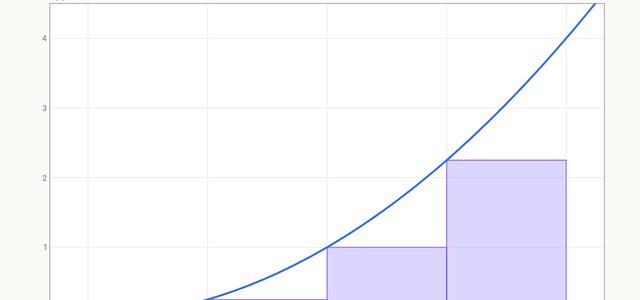
Open the Riemann Sums & the Fundamental Theorem simulation and test every idea on this page yourself.
Open the simulation →