The big idea
Differentiation finds the gradient of a curve at any point. The gradient function dy/dx tells you where the curve rises and falls, and where it is flat: the stationary points, which are the maxima and minima of the curve.
Key ideas
- Power rule: bring the power down and reduce it by one. Rewrite roots and fractions as powers of x first.
- The tangent at a point has gradient dy/dx; the normal has gradient −1/(dy/dx).
- Stationary points occur where dy/dx = 0.
- Second derivative positive: minimum. Negative: maximum.
- A function is increasing where dy/dx > 0.
Equations
| y = xn ⇒ dy/dx = nxn−1 | power rule |
| y − y1 = m(x − x1) | tangent or normal |
| dy/dx = 0 | stationary point |
| d2y/dx2 > 0 ⇒ minimum | second derivative test |
Worked questions: easy, medium, hard
Three questions that climb in difficulty, each solved one step at a time. Try each one before you read the steps.
Differentiate y = x3 − 4x2 + 2.
- x3 gives 3x2.
- −4x2 gives −8x, and the constant gives 0.
- dy/dx = 3x2 − 8x.
Find the equation of the tangent to y = x2 − 3x at the point where x = 2.
- y = 4 − 6 = −2, so the point is (2, −2).
- dy/dx = 2x − 3, which is 1 at x = 2.
- y + 2 = 1(x − 2), so y = x − 4.
Find and classify the stationary points of y = x3 − 6x2 + 9x + 1.
- dy/dx = 3x2 − 12x + 9 = 3(x − 1)(x − 3), so x = 1 or x = 3.
- y(1) = 1 − 6 + 9 + 1 = 5 and y(3) = 27 − 54 + 27 + 1 = 1.
- d2y/dx2 = 6x − 12: at x = 1 it is −6 (maximum); at x = 3 it is +6 (minimum).
- Maximum (1, 5), minimum (3, 1).
Common mistakes
- Differentiating 2/x as 2 instead of rewriting it as 2x−1.
- Using the tangent gradient for the normal.
- Finding x at a stationary point but not y.
Now you try: easy to hard
Six more questions, two at each level. These are the questions on the worksheet; each solution opens when you are ready.
Easy 1. Differentiate y = 5x4 + 3x.
Show the step-by-step solution
dy/dx = 20x3 + 3.
Easy 2. Differentiate y = 4√x + 2/x.
Show the step-by-step solution
y = 4x1/2 + 2x−1, so dy/dx = 2x−1/2 − 2x−2 = 2/√x − 2/x2.
Medium 3. Find the gradient of y = x2 + 1/x at x = 1.
Show the step-by-step solution
dy/dx = 2x − 1/x2 = 2 − 1 = 1.
Medium 4. For which values of x is y = x2 − 8x increasing?
Show the step-by-step solution
dy/dx = 2x − 8 > 0 when x > 4.
Hard 5. Find the normal to y = x3 at the point (1, 1).
Show the step-by-step solution
Tangent gradient 3x2 = 3, so normal gradient −1/3: y − 1 = −(1/3)(x − 1).
Hard 6. A rectangular pen is built against a wall using 40 m of fence for the other three sides. Find the largest possible area.
Show the step-by-step solution
Sides x, x and 40 − 2x. A = 40x − 2x2, dA/dx = 40 − 4x = 0 at x = 10. A = 10 × 20 = 200 m².
6 questions to print or save, with full step-by-step answers at the end.
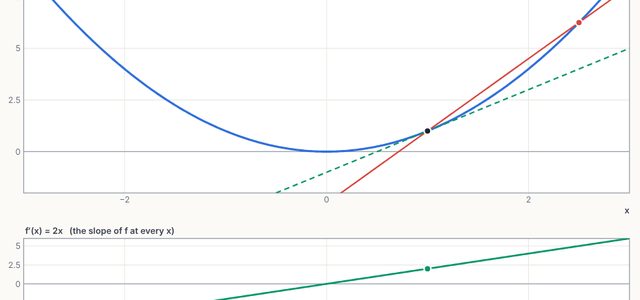
Open the Derivative Explorer simulation and test every idea on this page yourself.
Open the simulation →