The big idea
Current is the flow of charge, measured in amps. Potential difference (voltage) is the energy transferred per coulomb of charge. Resistance is how hard it is for current to flow. The three are linked by V = IR.
Key ideas
- Charge = current × time. Current is the same all the way round a series circuit.
- In series: the current is the same in each component, the voltages add up to the supply voltage, and the resistances add.
- In parallel: each branch has the full supply voltage, and the branch currents add up to the total. Adding a branch lowers the total resistance.
- An ammeter goes in series. A voltmeter goes in parallel.
- A filament lamp's resistance rises as it heats up. A thermistor's falls when hot, and an LDR's falls in bright light.
Equations
| Q = It | charge |
| V = IR | resistance |
| R = R₁ + R₂ | series |
Worked example
A 12 V battery is connected to a 4.0 Ω and a 2.0 Ω resistor in series. Find the current and the voltage across each resistor.
- Total resistance = 4.0 + 2.0 = 6.0 Ω.
- I = V/R = 12/6.0 = 2.0 A through both.
- V = IR: 2.0 × 4.0 = 8.0 V and 2.0 × 2.0 = 4.0 V. They add to 12 V ✓
Structured problems with diagrams
Longer problems solved one decision at a time: draw the diagram, find each force or field, resolve it into components, then add.
Problem 1. A circuit with series and parallel parts
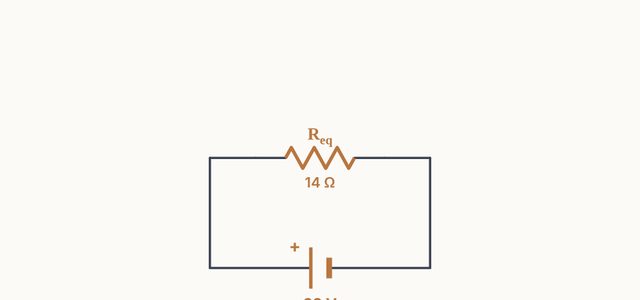
A 12 V battery is connected to a 4 Ω resistor in series with a parallel pair of 6 Ω and 3 Ω resistors. Find the current from the battery, the voltage across each part and the current in each branch.
- Combine the parallel pair1/R = 1/6 + 1/3 = 3/6, so the pair is equivalent to 2 Ω. (It must be smaller than the smallest branch.)
- Total resistance4 + 2 = 6 Ω.
- Battery currentI = V/R = 12/6 = 2.0 A. This all flows through the 4 Ω resistor.
- Share the voltageAcross the 4 Ω resistor: V = 2.0 × 4 = 8 V. That leaves 12 − 8 = 4 V across the parallel pair.
- Branch currentsI = V/R: 4/6 = 0.67 A in the 6 Ω branch and 4/3 = 1.33 A in the 3 Ω branch.
- Check0.67 + 1.33 = 2.0 A ✓. The smaller resistance takes the larger current.
Common mistakes
- Saying current is "used up" by a bulb. The current is the same before and after it; energy is what is transferred.
- Adding resistances for a parallel circuit.
Try it yourself
How much charge flows when 0.50 A passes for 2 minutes?
Show the answer
Q = It = 0.50 × 120 = 60 C.
Going deeper: GCSE exam level
Exam technique, a longer multi-step worked example and exam-style practice with hidden solutions.
Components that change resistance
A filament lamp gets hotter as the current rises, so its resistance increases and its I–V graph curves. A diode conducts in one direction only. A thermistor has a lower resistance when hot, and an LDR has a lower resistance in bright light: both are used as sensors.
More worked examples
Example 1. A lamp carries 0.30 A at 2.0 V and 0.50 A at 6.0 V. Find its resistance at each voltage and explain the change. Then find the total current when 6 Ω and 3 Ω resistors are connected in parallel across 12 V.
- At 2.0 V: R = 2.0/0.30 = 6.7 Ω. At 6.0 V: R = 6.0/0.50 = 12 Ω.
- The filament is hotter at the higher current, so its resistance is larger.
- Parallel: each resistor has 12 V. I = 12/6 = 2.0 A and 12/3 = 4.0 A.
- Total = 6.0 A, so the combined resistance is 12/6.0 = 2 Ω, less than either resistor.
Exam-style practice
1. Three 4 Ω resistors are connected in series to a 6 V battery. Find the current.
Show the solution
R = 12 Ω, so I = 6/12 = 0.50 A.
2. What happens to the resistance of an LDR when the lights are switched off?
Show the solution
It increases.
Where this fits in each exam board
| Cambridge IGCSE (0625) | Topic 4: Electricity and magnetism |
| Edexcel International GCSE (4PH1) | Section 2: Electricity |
| AQA GCSE (8463) | 4.2 Electricity |
4 questions to print or save, with full step-by-step answers at the end.
Open the Resistor Network Simplifier simulation and test every idea on this page yourself.
Open the simulation →