The big idea
Everything is made of tiny particles. In a solid they vibrate in fixed positions, in a liquid they slide past each other, and in a gas they fly about at high speed. Gas pressure comes from particles hitting the walls of the container.
Key ideas
- Heating a gas makes its particles move faster, so they hit the walls harder and more often.
- At constant temperature, squeezing a gas into half the volume doubles its pressure.
- At constant volume, pressure is proportional to the kelvin temperature.
- Kelvin = Celsius + 273. At absolute zero (0 K) particles have the least possible energy.
Equations
| p₁V₁ = p₂V₂ | constant temperature |
| p₁ / T₁ = p₂ / T₂ | constant volume (T in kelvin) |
| T (K) = θ (°C) + 273 |
Worked example
A gas at 100 kPa has a volume of 0.60 m³. It is compressed to 0.20 m³ at constant temperature. Find the new pressure.
- p₁V₁ = p₂V₂ → 100 × 0.60 = p₂ × 0.20.
- p₂ = 60/0.20 = 300 kPa.
- A third of the volume gives three times the pressure.
Common mistakes
- Using °C in the pressure–temperature law. Always convert to kelvin.
- Saying particles expand when heated. They move faster and spread out; the particles themselves stay the same size.
Try it yourself
A sealed can at 27 °C and 100 kPa is heated to 327 °C. Find the new pressure.
Show the answer
T₁ = 300 K, T₂ = 600 K: the kelvin temperature doubles, so p = 200 kPa.
Going deeper: GCSE exam level
Exam technique, a longer multi-step worked example and exam-style practice with hidden solutions.
Explaining gas pressure
A full answer has three parts: particles move randomly at high speed; they collide with the walls; each collision exerts a force, and force per unit area is pressure. Heating at constant volume makes the particles faster, so collisions are harder and more frequent. Squeezing at constant temperature packs the particles closer, so collisions are more frequent.
More worked examples
Example 1. An air bubble has a volume of 2.0 cm³ at a depth where the pressure is 300 kPa. Find its volume at the surface (100 kPa), at the same temperature. A tyre at 200 kPa and 7 °C warms to 35 °C at constant volume: find the new pressure.
- Bubble: p₁V₁ = p₂V₂ → 300 × 2.0 = 100 × V₂, so V₂ = 6.0 cm³.
- Tyre: convert to kelvin: 280 K and 308 K.
- p₂ = 200 × 308/280 = 220 kPa.
Exam-style practice
1. Convert 25 °C and −273 °C to kelvin.
Show the solution
298 K and 0 K (absolute zero).
2. A bicycle pump gets warm when used. Why?
Show the solution
Work is done on the gas when it is compressed, which increases its internal energy and so its temperature.
Where this fits in each exam board
| Cambridge IGCSE (0625) | Topic 2: Thermal physics |
| Edexcel International GCSE (4PH1) | Section 5: Solids, liquids and gases |
| AQA GCSE (8463) | 4.3 Particle model of matter |
4 questions to print or save, with full step-by-step answers at the end.
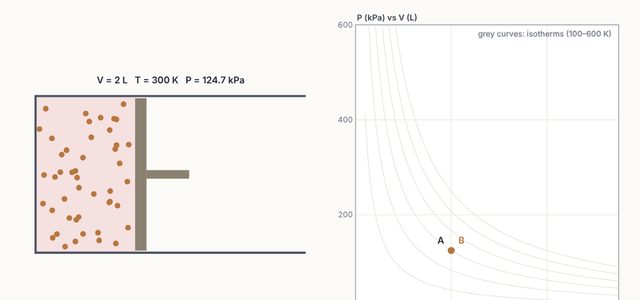
Open the Gas Laws & PV Diagrams simulation and test every idea on this page yourself.
Open the simulation →