The big idea
Heating a substance does one of two things. It either raises the temperature (the particles move faster) or it changes the state (the particles break free of each other) while the temperature stays constant. Two numbers describe this: the specific heat capacity and the specific latent heat.
Key ideas
- Internal energy is the total kinetic and potential energy of all the particles.
- Specific heat capacity c: the energy needed to raise 1 kg by 1 °C.
- During melting or boiling the temperature does not change: the energy goes into separating the particles.
- Specific latent heat L: the energy needed to change the state of 1 kg with no temperature change.
- Heat travels by conduction, convection and radiation. Insulation reduces all three.
Equations
| ΔE = mcΔθ | temperature change |
| E = mL | change of state |
Worked example
How much energy is needed to heat 2.0 kg of water from 20 °C to 100 °C, and then to boil away 0.50 kg of it? (c = 4200 J/kg °C, L = 2.26 × 10⁶ J/kg)
- Heating: ΔE = mcΔθ = 2.0 × 4200 × 80 = 672 000 J.
- Boiling: E = mL = 0.50 × 2.26 × 10⁶ = 1 130 000 J.
- Boiling a quarter of the water takes more energy than heating all of it by 80 °C.
Common mistakes
- Using the final temperature instead of the temperature change.
- Expecting the temperature to rise during melting or boiling.
Try it yourself
A 0.50 kg aluminium block (c = 900 J/kg °C) receives 9000 J. Find its temperature rise.
Show the answer
Δθ = E/(mc) = 9000/(0.50 × 900) = 20 °C.
Going deeper: GCSE exam level
Exam technique, a longer multi-step worked example and exam-style practice with hidden solutions.
The specific heat capacity practical
Heat a 1 kg block with an electrical heater, measure the energy with a joulemeter (or from E = Pt = IVt) and record the temperature rise. The value of c usually comes out too high, because some energy heats the surroundings instead of the block. Insulating the block reduces this error.
More worked examples
Example 1. A 50 W heater runs for 300 s and warms a 1.0 kg aluminium block by 15 °C. Calculate the specific heat capacity. The accepted value is 900 J/kg °C: explain the difference.
- E = Pt = 50 × 300 = 15 000 J.
- c = E/(mΔθ) = 15 000/(1.0 × 15) = 1000 J/kg °C.
- This is too high: some of the 15 000 J was transferred to the air, so less than that actually heated the block. Insulation would improve the result.
Exam-style practice
1. How much energy is needed to melt 0.20 kg of ice at 0 °C? (L = 334 000 J/kg)
Show the solution
E = mL = 0.20 × 334 000 = 66 800 J.
2. Why does steam at 100 °C cause a worse burn than water at 100 °C?
Show the solution
The steam also releases its latent heat as it condenses on the skin, before it cools as water.
Where this fits in each exam board
| Cambridge IGCSE (0625) | Topic 2: Thermal physics |
| Edexcel International GCSE (4PH1) | Section 5: Solids, liquids and gases; Section 4: Energy resources and energy transfers |
| AQA GCSE (8463) | 4.1 Energy; 4.3 Particle model of matter |
4 questions to print or save, with full step-by-step answers at the end.
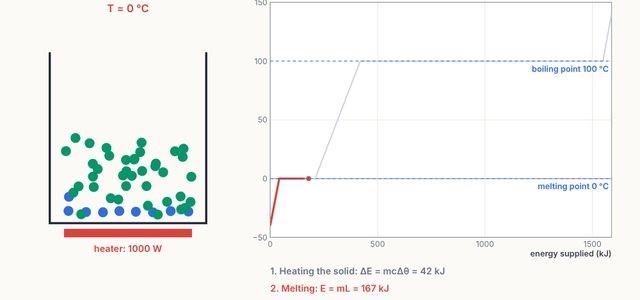
Open the Heating Curve simulation and test every idea on this page yourself.
Open the simulation →