The big idea
Energy is never created or destroyed. It is only transferred from one store to another: kinetic, gravitational potential, elastic, thermal, chemical and others. Work is energy transferred by a force. Power is how quickly energy is transferred.
Key ideas
- Work done = force × distance moved in the direction of the force.
- A moving object has kinetic energy. A raised object has gravitational potential energy.
- Conservation of energy: the total energy stays the same. "Wasted" energy usually ends up heating the surroundings.
- Power is energy transferred per second: 1 watt = 1 joule per second.
- Efficiency = useful energy out ÷ total energy in. It can never be more than 100%.
Equations
| W = Fd | work done |
| Ek = ½mv² | kinetic energy |
| Ep = mgh | gravitational potential energy |
| P = E / t | power |
| efficiency = useful out / total in |
Worked example
A 50 kg student runs up stairs 3.0 m high in 5.0 s. Find the energy gained and the power.
- Ep = mgh = 50 × 9.8 × 3.0 = 1470 J.
- P = E/t = 1470/5.0 = 294 W.
Common mistakes
- Forgetting to square the speed in ½mv².
- Saying energy is "used up". It is transferred to less useful stores.
Try it yourself
A motor takes in 500 J and lifts a load, giving it 350 J. What is its efficiency?
Show the answer
350/500 = 0.70 = 70%. The other 150 J heats the motor and surroundings.
Going deeper: GCSE exam level
Exam technique, a longer multi-step worked example and exam-style practice with hidden solutions.
Energy audits
For any process, write down the energy store at the start, the store at the end, and what is wasted. With no losses, the loss in gravitational potential energy equals the gain in kinetic energy, so v = √(2gh). Real answers are always smaller, and the difference is the energy transferred to thermal stores by friction and air resistance. Lubrication and streamlining reduce the waste.
More worked examples
Example 1. A 500 kg roller-coaster car starts from rest and drops 20 m. Find the speed it would reach with no friction. Its measured speed is 18 m/s: how much energy was wasted?
- Ep lost = mgh = 500 × 9.8 × 20 = 98 000 J.
- With no friction: ½mv² = 98 000, so v = √(2 × 98 000/500) = 19.8 m/s.
- Actual Ek = ½ × 500 × 18² = 81 000 J.
- Wasted = 98 000 − 81 000 = 17 000 J (17%).
Exam-style practice
1. A 1000 kg car travels at 30 m/s. Find its kinetic energy. What happens to it if the speed doubles?
Show the solution
½ × 1000 × 30² = 450 000 J. Doubling the speed makes it four times larger.
2. A lamp takes in 20 W and gives out 15 W as light. Find its efficiency.
Show the solution
15/20 = 75%.
Where this fits in each exam board
| Cambridge IGCSE (0625) | Topic 1: Motion, forces and energy |
| Edexcel International GCSE (4PH1) | Section 4: Energy resources and energy transfers |
| AQA GCSE (8463) | 4.1 Energy |
4 questions to print or save, with full step-by-step answers at the end.
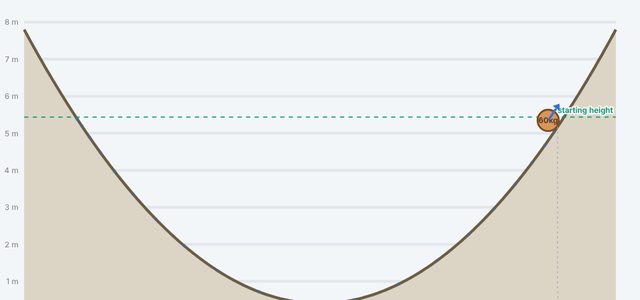
Open the Energy Skate Track simulation and test every idea on this page yourself.
Open the simulation →