The big idea
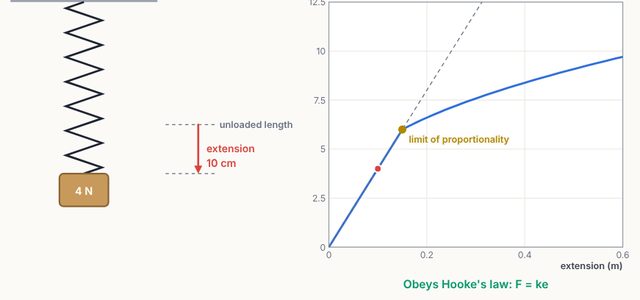
Stretch a spring and it pulls back. For most springs the extension is directly proportional to the force, up to a point called the limit of proportionality. A stretched spring stores elastic potential energy.
Key ideas
- Extension is the increase in length, not the total length.
- Hooke's law: force = spring constant × extension, up to the limit of proportionality.
- A stiffer spring has a larger spring constant k.
- Elastic deformation: the object returns to its shape. Inelastic (plastic) deformation: it stays stretched.
- The energy stored is the area under the force–extension graph.
Equations
| F = ke | Hooke's law |
| E = ½ke² | elastic potential energy |
Worked example
A 2.0 N load stretches a spring by 0.040 m. Find the spring constant and the energy stored when the extension is 0.10 m.
- k = F/e = 2.0/0.040 = 50 N/m.
- E = ½ke² = ½ × 50 × 0.10² = 0.25 J.
Common mistakes
- Using the full length of the spring instead of the extension.
- Using centimetres for extension with k in N/m.
Try it yourself
A spring with k = 200 N/m is stretched by 3.0 cm. What force is needed?
Show the answer
F = 200 × 0.030 = 6.0 N.
Going deeper: GCSE exam level
Exam technique, a longer multi-step worked example and exam-style practice with hidden solutions.
The required practical
Hang the spring beside a clamped ruler, add weights one at a time and record the extension each time. Plot force against extension and draw a best-fit line. The gradient of the straight part is the spring constant. Two identical springs side by side (parallel) are twice as stiff; end to end (series) they are half as stiff.
More worked examples
Example 1. A spring gives these results: 1.0 N → 2.0 cm, 2.0 N → 4.0 cm, 3.0 N → 6.0 cm, 4.0 N → 8.0 cm, 5.0 N → 11.5 cm. Find the spring constant, say where the limit of proportionality is, and find the energy stored at 8.0 cm.
- Up to 4.0 N each newton adds 2.0 cm, so k = 1.0/0.020 = 50 N/m.
- The last reading is not on the line (it would be 10.0 cm), so the limit of proportionality is between 4.0 N and 5.0 N.
- E = ½ke² = ½ × 50 × 0.080² = 0.16 J.
Exam-style practice
1. Two springs, each with k = 50 N/m, hang side by side and share a 6.0 N load. Find the extension.
Show the solution
Combined k = 100 N/m, so e = 6.0/100 = 0.060 m.
2. A toy spring (k = 200 N/m) is compressed by 0.050 m and fires a 0.010 kg dart. Find the dart's speed.
Show the solution
E = ½ × 200 × 0.050² = 0.25 J = ½mv², so v = √(2 × 0.25/0.010) = 7.1 m/s.
Where this fits in each exam board
| Cambridge IGCSE (0625) | Topic 1: Motion, forces and energy |
| Edexcel International GCSE (4PH1) | Section 1: Forces and motion |
| AQA GCSE (8463) | 4.5 Forces |
4 questions to print or save, with full step-by-step answers at the end.
Open the Springs & Materials simulation and test every idea on this page yourself.
Open the simulation →