The big idea
Density tells you how much mass is packed into each cubic metre. Pressure tells you how concentrated a force is: the same force on a smaller area gives a bigger pressure. In a liquid, pressure increases with depth, which is why dams are thicker at the bottom.
Key ideas
- Density = mass ÷ volume. Solids and liquids are dense because their particles are close together.
- Pressure = force ÷ area, in pascals (1 Pa = 1 N/m²).
- Pressure in a liquid acts in all directions and increases with depth and with the liquid's density.
- An object floats if it is less dense than the liquid. The upward force from the liquid is called upthrust.
Equations
| ρ = m / V | density (kg/m³) |
| p = F / A | pressure |
| p = hρg | pressure due to a liquid column |
Worked example
A block measuring 0.20 m × 0.10 m × 0.050 m has a mass of 2.7 kg. Find its density and the pressure it exerts when resting on its largest face.
- Volume = 0.20 × 0.10 × 0.050 = 0.0010 m³, so ρ = 2.7/0.0010 = 2700 kg/m³.
- Weight = 2.7 × 9.8 = 26.5 N. Largest face area = 0.20 × 0.10 = 0.020 m².
- p = 26.5/0.020 = 1320 Pa.
Common mistakes
- Using cm² for area with newtons and calling the answer pascals. Convert to m² first.
- Thinking pressure in a liquid depends on the shape or width of the container. It depends only on depth and density.
Try it yourself
Find the pressure due to the water at a depth of 3.0 m in a pool (ρ = 1000 kg/m³).
Show the answer
p = hρg = 3.0 × 1000 × 9.8 = 29 400 Pa.
Going deeper: GCSE exam level
Exam technique, a longer multi-step worked example and exam-style practice with hidden solutions.
Measuring density and using pressure
For an irregular solid, find the volume from the rise in water level in a measuring cylinder (1 cm³ = 1 ml). Total pressure under water is atmospheric pressure (about 100 kPa) plus hρg. Hydraulic machines work because pressure is transmitted equally through a liquid: a small force on a small piston gives a large force on a large piston.
More worked examples
Example 1. A stone of mass 135 g raises the water level in a measuring cylinder from 60 cm³ to 110 cm³. Find its density in kg/m³. Then find the total pressure on a diver 20 m down in sea water (ρ = 1030 kg/m³; atmospheric pressure 101 kPa).
- Volume = 110 − 60 = 50 cm³; density = 135/50 = 2.7 g/cm³ = 2700 kg/m³.
- Water pressure = hρg = 20 × 1030 × 9.8 = 202 kPa.
- Total = 202 + 101 = 303 kPa, about three times atmospheric pressure.
Exam-style practice
1. A force of 50 N pushes a piston of area 0.0010 m². What force does the liquid exert on a second piston of area 0.020 m²?
Show the solution
Pressure = 50/0.0010 = 50 000 Pa; force = 50 000 × 0.020 = 1000 N.
2. Why do snowshoes stop you sinking into snow?
Show the solution
Your weight is spread over a larger area, so the pressure is smaller.
Where this fits in each exam board
| Cambridge IGCSE (0625) | Topic 1: Motion, forces and energy |
| Edexcel International GCSE (4PH1) | Section 5: Solids, liquids and gases |
| AQA GCSE (8463) | 4.3 Particle model of matter (density); 4.5 Forces (pressure) |
4 questions to print or save, with full step-by-step answers at the end.
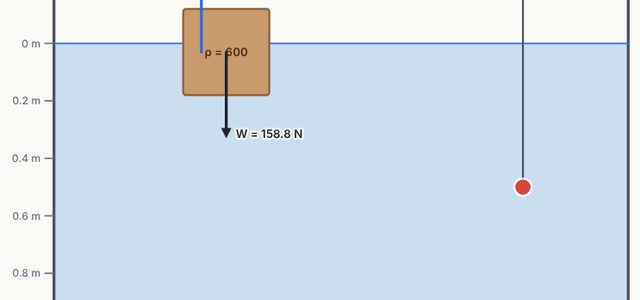
Open the Fluids Lab simulation and test every idea on this page yourself.
Open the simulation →