The big idea
A force can turn an object as well as move it. The turning effect is called the moment: force × perpendicular distance from the pivot. A balanced object has equal clockwise and anticlockwise moments.
Key ideas
- Moment = force × perpendicular distance from the pivot, in newton metres (N m).
- Principle of moments: for a balanced object, total clockwise moment = total anticlockwise moment.
- A long spanner or lever gives a bigger moment for the same force.
- The centre of mass is the point where the weight seems to act. An object topples when its centre of mass moves outside its base.
Equations
| M = Fd | moment |
| Σ clockwise = Σ anticlockwise | balance |
Worked example
A child weighing 400 N sits 1.5 m from the pivot of a seesaw. How far from the pivot must a 600 N adult sit to balance it?
- Child's moment = 400 × 1.5 = 600 N m.
- For balance: 600 × d = 600.
- d = 1.0 m on the other side of the pivot.
Common mistakes
- Measuring the distance along the object instead of at right angles to the force.
- Forgetting the weight of the beam itself when the pivot is not at its centre.
Try it yourself
A 15 N force acts on the end of a 0.30 m spanner. What is its moment?
Show the answer
15 × 0.30 = 4.5 N m.
Going deeper: GCSE exam level
Exam technique, a longer multi-step worked example and exam-style practice with hidden solutions.
When the beam has weight
If the pivot is not at the centre of a uniform beam, the beam's own weight has a moment. Treat the whole weight as acting at the centre of mass, in the middle of the beam. Levers and gears are force multipliers: a small force far from the pivot balances a large force close to it.
More worked examples
Example 1. A uniform metre rule of weight 1.0 N is pivoted at the 30 cm mark. A 2.0 N weight hangs from the 10 cm mark. What weight must hang from the 90 cm mark to balance the rule?
- Anticlockwise: 2.0 N at 0.20 m from the pivot = 0.40 N m.
- The rule's weight acts at the 50 cm mark, 0.20 m from the pivot: clockwise moment 1.0 × 0.20 = 0.20 N m.
- The extra clockwise moment needed is 0.40 − 0.20 = 0.20 N m, at 0.60 m from the pivot.
- W = 0.20/0.60 = 0.33 N.
Exam-style practice
1. A crowbar is pushed down with 100 N at 0.80 m from the pivot. What force does it apply to a nail 0.050 m from the pivot?
Show the solution
100 × 0.80 = F × 0.050, so F = 1600 N.
2. Why does a double-decker bus carry more passengers downstairs than upstairs when testing its stability?
Show the solution
A low centre of mass must be tilted further before it passes outside the wheelbase, so the bus is harder to topple.
Where this fits in each exam board
| Cambridge IGCSE (0625) | Topic 1: Motion, forces and energy |
| Edexcel International GCSE (4PH1) | Section 1: Forces and motion |
| AQA GCSE (8463) | 4.5 Forces |
4 questions to print or save, with full step-by-step answers at the end.
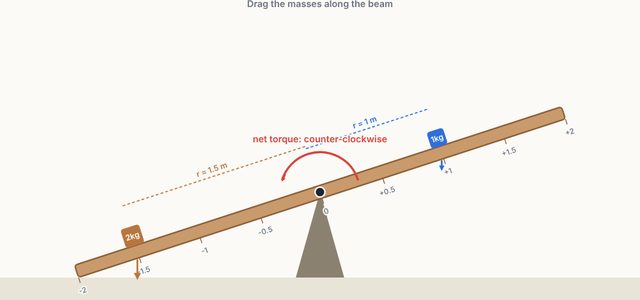
Open the Torque & Balance simulation and test every idea on this page yourself.
Open the simulation →