The big idea
Momentum is mass × velocity. In any collision or explosion, the total momentum before equals the total momentum after, as long as no outside force acts. To change an object's momentum you need a force, and the longer the time taken, the smaller the force.
Key ideas
- Momentum is a vector: give it a sign for direction.
- Total momentum is conserved in collisions and explosions.
- Force = change in momentum ÷ time. Seat belts, air bags and crumple zones increase the time of a collision to reduce the force.
- Stopping distance = thinking distance + braking distance. Braking distance grows with the square of the speed.
Equations
| p = mv | momentum (kg m/s) |
| F = Δp / Δt | force and momentum |
| m₁u₁ + m₂u₂ = m₁v₁ + m₂v₂ | conservation |
Worked example
A 2.0 kg trolley moving at 3.0 m/s hits a stationary 1.0 kg trolley and they stick together. Find their speed afterwards.
- Momentum before = 2.0 × 3.0 + 0 = 6.0 kg m/s.
- Afterwards the combined mass is 3.0 kg: 3.0 × v = 6.0.
- v = 2.0 m/s in the original direction.
Common mistakes
- Forgetting that a stationary object has zero momentum, not zero mass.
- Thinking doubling the speed doubles the braking distance. It makes it four times longer.
Try it yourself
A 0.40 kg ball moving at 15 m/s is stopped in 0.050 s. Find the force.
Show the answer
Δp = 0.40 × 15 = 6.0 kg m/s; F = 6.0/0.050 = 120 N.
Going deeper: GCSE exam level
Exam technique, a longer multi-step worked example and exam-style practice with hidden solutions.
Thinking, braking and stopping
Thinking distance = speed × reaction time, so it is proportional to speed. Tiredness, alcohol, drugs and distractions increase it. Braking distance depends on speed squared, and increases on wet or icy roads and with worn brakes or tyres. In braking, the car's kinetic energy is transferred to thermal energy in the brakes.
More worked examples
Example 1. A 1500 kg car travels at 20 m/s. The driver's reaction time is 0.70 s and the brakes then give a deceleration of 5.0 m/s². Find the stopping distance. Compare the force on the car when it stops in 4.0 s with the force in a crash lasting 0.10 s.
- Thinking distance = 20 × 0.70 = 14 m.
- Braking distance: v² = u² + 2as → 0 = 20² − 2 × 5.0 × s, so s = 40 m.
- Stopping distance = 14 + 40 = 54 m.
- Change in momentum = 1500 × 20 = 30 000 kg m/s. Braking: 30 000/4.0 = 7500 N. Crash: 30 000/0.10 = 300 000 N, forty times larger.
Exam-style practice
1. Two skaters stand still. A 60 kg skater pushes a 40 kg skater, who moves off at 3.0 m/s. Find the velocity of the 60 kg skater.
Show the solution
Total momentum stays zero: 60v + 40 × 3.0 = 0, so v = −2.0 m/s (2.0 m/s the other way).
2. The braking distance at 20 m/s is 40 m. What is it at 40 m/s?
Show the solution
Speed doubles, so braking distance is ×4: 160 m.
Where this fits in each exam board
| Cambridge IGCSE (0625) | Topic 1: Motion, forces and energy |
| Edexcel International GCSE (4PH1) | Section 1: Forces and motion |
| AQA GCSE (8463) | 4.5 Forces |
4 questions to print or save, with full step-by-step answers at the end.
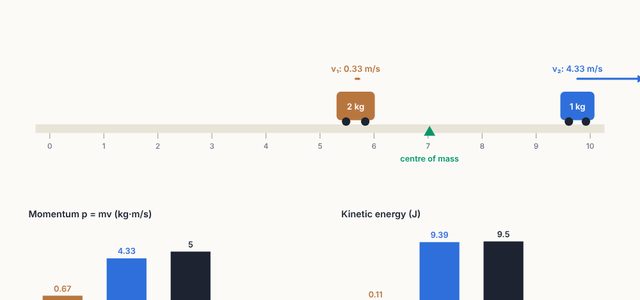
Open the Collisions & Momentum simulation and test every idea on this page yourself.
Open the simulation →