The big idea
A force is a push or a pull, measured in newtons. What matters is the resultant force: the single force that has the same effect as all the forces acting together. If the resultant is zero the motion does not change. If it is not zero, the object accelerates.
Key ideas
- First law: with zero resultant force, an object stays at rest or keeps moving at a constant velocity.
- Second law: resultant force = mass × acceleration.
- Third law: when A pushes B, B pushes A with an equal and opposite force. The two forces act on different objects.
- Weight is the force of gravity on an object, W = mg. Mass is the amount of matter and does not change from place to place.
- A falling object reaches terminal velocity when air resistance grows to equal its weight.
Equations
| F = ma | resultant force |
| W = mg | weight |
| g ≈ 9.8 N/kg | on Earth |
Worked example
A 1200 kg car has a driving force of 3000 N and total resistive forces of 600 N. Find its acceleration.
- Resultant force = 3000 − 600 = 2400 N forwards.
- a = F/m = 2400/1200 = 2.0 m/s².
- As the car speeds up, air resistance grows, so the acceleration falls until the forces balance.
Common mistakes
- Using the driving force alone in F = ma. Always use the resultant force.
- Saying a moving object needs a force to keep moving. It only needs one to change its motion.
Try it yourself
What is the weight of a 65 kg person on Earth, and on the Moon where g = 1.6 N/kg?
Show the answer
Earth: 65 × 9.8 = 637 N. Moon: 65 × 1.6 = 104 N. The mass is 65 kg in both places.
Going deeper: GCSE exam level
Exam technique, a longer multi-step worked example and exam-style practice with hidden solutions.
Terminal velocity, step by step
Exam answers need the full chain. (1) At first weight is greater than air resistance, so there is a resultant force down and the object accelerates. (2) As speed increases, air resistance increases, so the resultant force and the acceleration get smaller. (3) When air resistance equals weight, the resultant force is zero and the object falls at a constant terminal velocity.
Forces at right angles
Two forces at right angles can be combined with a scale drawing or Pythagoras. A single force can also be resolved into two components at right angles.
More worked examples
Example 1. An 80 kg skydiver falls with air resistance of 300 N. Find the acceleration. What is the air resistance at terminal velocity? When the parachute opens the air resistance becomes 1200 N: describe the motion.
- Weight = 80 × 9.8 = 784 N. Resultant = 784 − 300 = 484 N down, so a = 484/80 = 6.1 m/s².
- At terminal velocity the forces balance: air resistance = 784 N.
- With the parachute: resultant = 1200 − 784 = 416 N upward, so the skydiver decelerates at 416/80 = 5.2 m/s² until a new, lower terminal velocity is reached.
Exam-style practice
1. Forces of 3.0 N east and 4.0 N north act on an object. Find the resultant.
Show the solution
√(3.0² + 4.0²) = 5.0 N, at 53° north of east.
2. A book rests on a table. Name the Newton's third law partner of the book's weight.
Show the solution
The gravitational pull of the book on the Earth. (The push of the table is a different type of force, so it is not the partner.)
Where this fits in each exam board
| Cambridge IGCSE (0625) | Topic 1: Motion, forces and energy |
| Edexcel International GCSE (4PH1) | Section 1: Forces and motion |
| AQA GCSE (8463) | 4.5 Forces |
4 questions to print or save, with full step-by-step answers at the end.
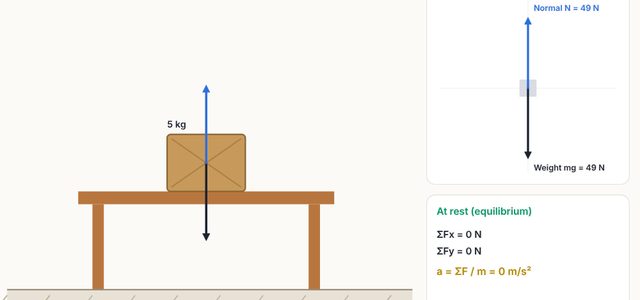
Open the Forces & Free-Body Diagrams simulation and test every idea on this page yourself.
Open the simulation →